

Popular:
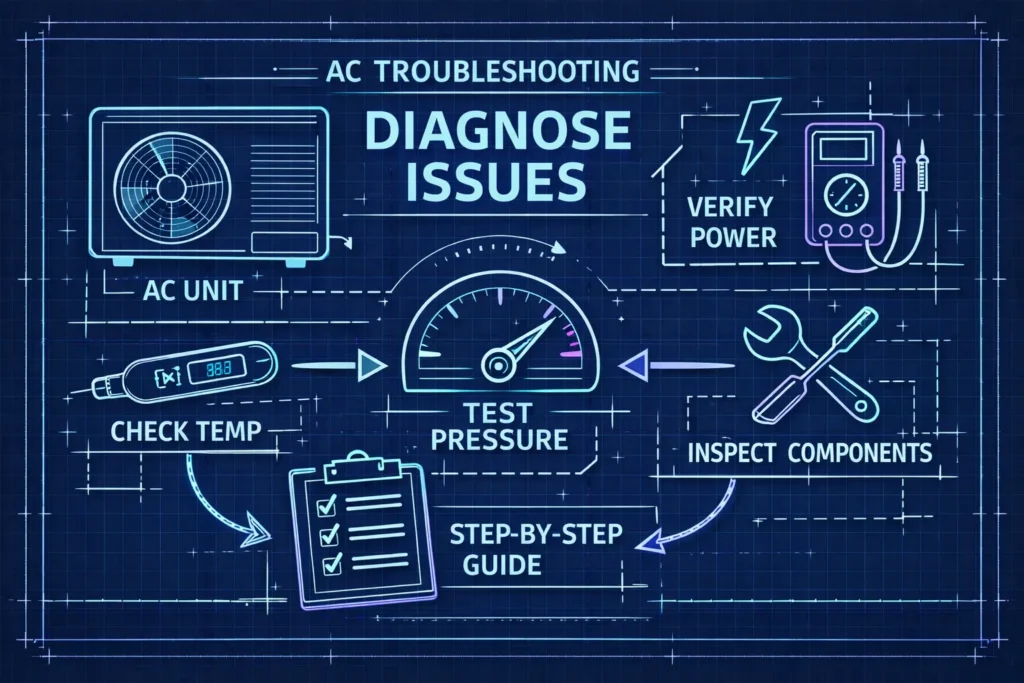
Table of Contents
AC troubleshooting starts with a few quick checks that resolve many “AC won’t turn on” problems and avoid an unnecessary service call. The five steps below guide homeowners, property managers, small business owners, and technicians through practical troubleshooting and routine maintenance for central air systems.
Quick summary
- Start with safety: confirm power, reset the HVAC breaker and outdoor disconnect, verify thermostat mode and fresh batteries, and do not work on live terminals.
- Check airflow and filters: replace dirty filters and clear supply and return vents; restricted airflow is the most common cause of poor cooling and short cycling.
- Inspect drain and coils: look for clogged condensate lines, pooled water, dirty or frozen coils, and debris around the outdoor unit; clear and clean as needed.
- Spot refrigerant problems: hissing, oily residue, or persistent ice on lines point to leaks or low refrigerant and require a professional diagnosis.
- Know when to call: shut the system down and contact a licensed HVAC technician for burning smells, breakers that will not reset, grinding noises, or when fixes fail.
Step 1: safety, power and thermostat basics
Start with the quickest checks you can do in minutes to confirm power and basic controls. Locate your breaker panel, switch the thermostat to OFF, then move the AC or HVAC breaker fully to OFF and back to ON; use the outdoor disconnect if your system has one. If the breaker trips immediately after resetting, stop and call an electrician or HVAC technician for safety.
Thermostat settings and power hide many problems, so verify mode and temperature setpoint before anything else. Set the thermostat to Cool, place the temperature 3 to 5 degrees below room temperature, and set the fan to Auto rather than On. Replace batteries if the display is dim or unresponsive, check wiring or scheduling on smart thermostats, and perform an outdoor unit power reset by turning the thermostat OFF and switching the outdoor disconnect or breaker to OFF for at least 30 minutes before powering back up.
If the outdoor fan or compressor still does not start after the reset, note any humming, clicking, or indicator lights and proceed to Step 2 or call a technician. Repeated failures, visible burning smells, or tripped breakers suggest electrical or mechanical faults that need professional diagnosis.
Step 2: airflow, filters and vents
Airflow problems are the single most common cause of poor cooling and short cycling, so rule them out early. Check the air filter monthly and replace disposable filters every 30 to 90 days depending on use and pets. Follow the airflow arrow when installing a new filter and note the size and replacement date on the frame; a visibly dark or compressed filter needs replacement and often restores normal airflow. For more detailed guidance on filter selection and replacement intervals, see the HVAC FAQ Hub Blog.
Inspect supply vents and return grilles for obstructions and confirm dampers are open. Move furniture, rugs, curtains, or toys that block registers and keep anything within about a foot of the return grille clear.
- All supply vents open and directed into the room
- Return grille free of obstructions and visually clean
- No large furniture directly in front of returns
If one room is warm while others are cool, the problem may be a duct balancing issue that requires a technician. A technician can adjust dampers or redistribute airflow to restore comfort.
Compare supply and return airflow while the system runs. Weak or no airflow at the supply with the blower running suggests a belt or motor problem or a major duct restriction; you can visually check for loose belts or obvious debris, but blower motor service is a professional task. If airflow checks are clear, move on to condensate, coil and outdoor unit inspections in the next step.
Step 3: condensate, coils and the outdoor unit
Clogged drains and dirty coils commonly show up as reduced cooling or a safety shutoff. If you see water pooling under the air handler, smell mustiness, or notice a tripped float switch, locate the overflow pan and drain access and clear the clog. Use a wet/dry vacuum at the outdoor stub or the indoor access point to pull the clog, then flush the line with a cup of hydrogen peroxide or white vinegar followed by water to slow algae growth; avoid forcing plumbing tools into coils or the drain connection. For step-by-step tips on cleaning condensate lines, consult Carrier’s guide to cleaning the AC drain line.
Keep the outdoor unit clear and clean the condenser coil to restore heat transfer and airflow. Shut power at the breaker, remove leaves and debris around the cabinet, and rinse the coil from the inside out with a garden hose on low pressure to knock loose dirt from the fins. If fins are bent or the coil is heavily fouled, call a technician since the wrong pressure or tool can damage fins and reduce efficiency.
Inspect the condenser fan and check for hard-start symptoms such as humming or a fan that will not spin freely. Bent blades, oil leaks, or a stubborn spin often point to a failing capacitor or motor, and capacitors can hold dangerous voltage; leave replacements to trained professionals. With drain and coil checks complete, proceed to Step 4 to look for refrigerant or leak indicators.
Step 4: refrigerant, ice and leak indicators
Low refrigerant and leaks create distinct, repeatable symptoms you can spot without opening the system. Listen for hissing or bubbling, look for oily residue on refrigerant lines or connections, and note persistent ice on the evaporator coil or suction line. When cooling drops while runtime increases and humidity stays high, the system is not moving heat efficiently and needs a charge check and leak inspection.
- Hissing or bubbling noises near lines or the outdoor unit
- Oily or greasy film on connections or service ports
- Ice buildup on coils or the suction line that returns after thawing
- Reduced cooling output with higher-than-normal indoor humidity
If you find ice, turn the cooling off and set the thermostat fan to ON to help dry the coil, or let the coil thaw naturally; a warm towel laid over the coil can speed thawing safely. Avoid chipping or forcing ice away, since that can bend fins or damage the coil. After thawing, replace a dirty filter and run the system briefly; if the evaporator freezes again, you likely have a refrigerant leak or a persistent airflow problem that requires a trained technician.
Refrigerant handling is regulated and technical work. Certified technicians use gauges, electronic leak detectors, UV dye, and recovery equipment to find and repair leaks, then recharge the system to EPA standards. To learn how professionals identify common refrigerant leak indicators, review the Lennox guide to identifying AC refrigerant leaks. Brazing copper, protecting the compressor, and handling refrigerant safely are not DIY tasks; call a certified technician to diagnose and fix leaks so you protect the system and comply with regulations.
Step 5: performance checks, short cycling and basic diagnostics
Start with a simple temperature-split test to confirm system performance. Measure the return and supply air with a thermometer and record both readings; a healthy central air system typically shows about a 15°F temperature split between return and supply. If the split is significantly smaller, heat transfer or airflow is not working as expected.
Time how long the compressor runs and how long it stays off between cycles, and jot those values down. Long runs with little or no cooling, and frequent cycles under 10 minutes, are diagnostic clues that narrow the problem set. Combine run-time notes with indoor humidity, visible ice, or uneven room temperatures for clearer ac troubleshooting guidance. Manufacturer resources can offer model-specific troubleshooting steps; for example, see Trane’s air conditioner troubleshooting guide.
Short cycling and strange noises often point to specific faults and help prioritize repairs. Common causes include airflow restriction, refrigerant issues, and starting or electrical faults that produce quick on/off cycles or humming. Use symptom severity to estimate urgency and a rough repair cost before calling a professional.
- Capacitor replacement: $80 to $600 — seeThis Old House’s capacitor cost guide
- Refrigerant recharge, plus leak repair if needed: $100 to $500
- Fan motor replacement: $200 to $700
- Compressor replacement: $750 to $2,000
- Thermostat replacement: $150 to $350
Immediate attention is needed for units that will not start, repeatedly trip breakers, or make grinding or metallic clunks. Warm-blowing on a hot day is high priority; low airflow is moderate. If symptoms persist after these checks, prepare for a technician visit using the guidance in the next section.
When to stop DIY and call a licensed HVAC technician
Shut the system down and call a licensed technician if you smell burning, see smoke, or breakers will not reset. Those are red flags for electrical faults or major mechanical failure and are unsafe for a homeowner to repair. Persistent refrigerant leaks, visible oil stains at line connections, or repeated short cycling after basic checks also require professional attention.
When weighing repair versus replacement, consider the unit’s age, recent service history, and the repair estimate. Systems older than 12 to 15 years, or repairs that would cost more than half the price of a new unit, often make replacement the better option, especially after a compressor failure. Always ask the technician for a written estimate, parts and labor warranty options, and a post-repair performance check so you know the system meets expected output.
Prepare for the technician by gathering model and serial numbers, photos or short videos of unusual noises or leaks, recent filter change dates, and the temperature split you measured at the vents. Note breaker status, thermostat settings, and any error codes or LED flashes from the indoor unit to speed diagnosis. Clear access to the outdoor unit and indoor air handler so the tech can work safely and start tests immediately.
HVAC FAQ Hub connects you with locally vetted professionals, verified reviews, and credential badges to simplify finding a qualified technician. Share the measurements and photos you collected through the request form to get faster, more accurate estimates and a focused initial diagnosis. Use the directory to compare providers and request quotes or emergency service when the problem requires a licensed technician.
Final checklist for ac troubleshooting
Run through these focused checks before scheduling a service call to narrow the problem and provide useful information to a technician. Inspect condensate lines, coils, and the outdoor unit for debris or frozen fins if the system runs but fails to cool. Keep a short note of what you tested and what changed to build a simple service history for future reference.